AI detects heart failure risk up to five years before diagnosis from routine 24-hour ECGs

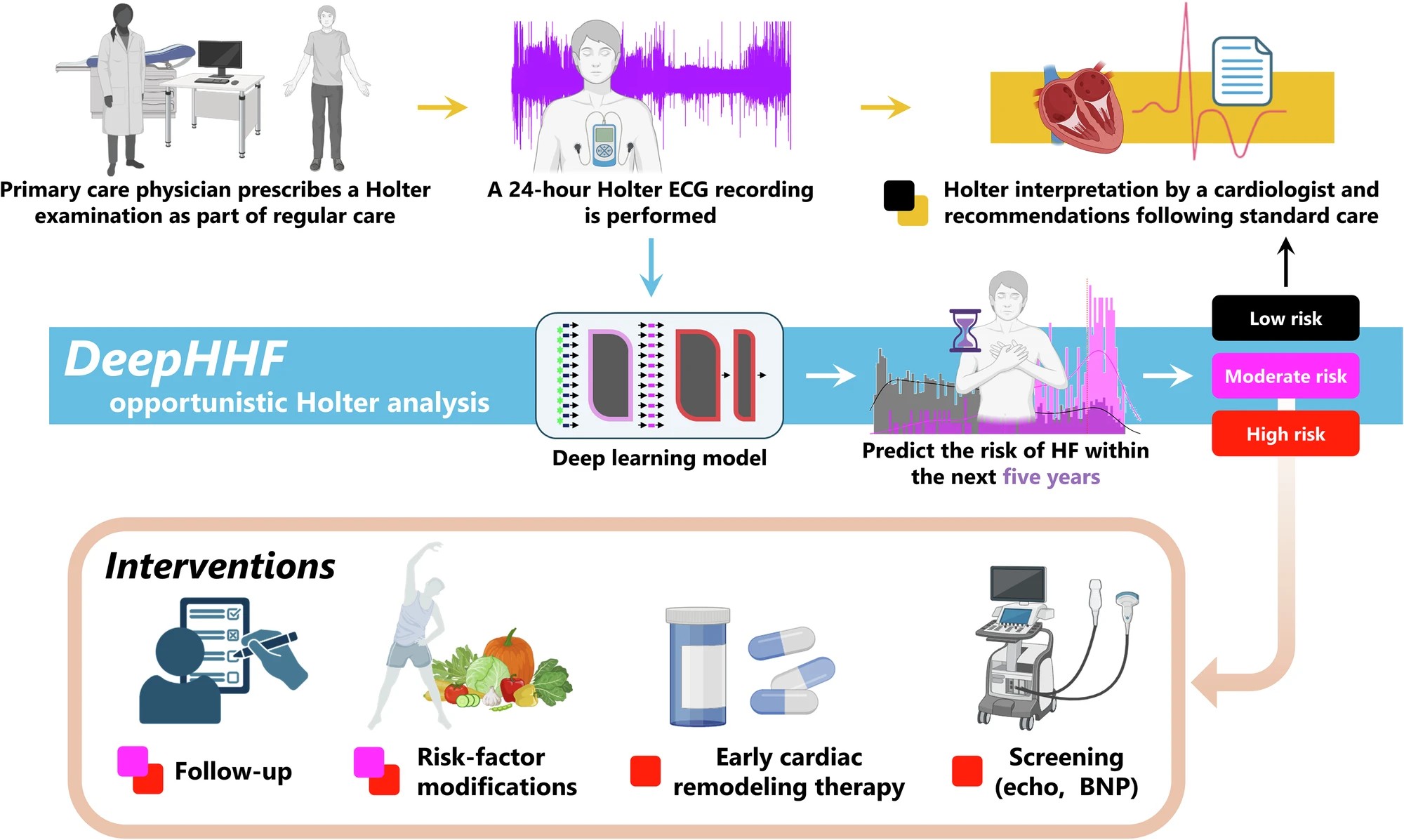
A team of investigators led by Prof. Joachim Behar of the Technion Faculty of Biomedical Engineering developed an artificial intelligence (AI) tool that can identify people at high risk of developing heart failure years before symptoms appear. The study, carried out by graduate students Eran Zvuloni and Shany Brimer Biton in collaboration with Dr. Ronit Almog from the Rambam Health Care Campus and Technion and investigators from the Shaare Zedek Medical Center, Leumit Health Services and Hadassah Medical Center, potentially opens a new window for preventive care against one of the world's leading causes of hospitalization and death. The deep learning system, DeepHHF, analyzes a standard 24-hour Holter electrocardiogram (ECG)—a routinely used test that continuously records the heart's electrical activity—and estimates an individual's likelihood of developing heart failure within the following five years. Unlike previous AI approaches that primarily detect existing heart dysfunction from short 12-lead ECG recordings, DeepHHF analyzes the complete 24-hour electrical signal from a single ECG lead, capturing subtle temporal patterns associated with future disease across the full spectrum of heart failure. The model was trained and evaluated using more than 57,000 Holter recordings from over 40,000 patients, linked to 20 years of longitudinal clinical data collected from primary care clinics across Israel. In independent testing, DeepHHF significantly outperformed the guideline-recommended PCP-HF clinical risk score and maintained its predictive performance in an external validation cohort.
Heart failure affects an estimated 64 million people worldwide, and early detection is critical because treatment is most effective before irreversible damage develops. The study demonstrates that prolonged ECG monitoring contains prognostic information that is missed by conventional short ECG recordings. By analyzing the entire 24-hour recording rather than a brief ECG snapshot, DeepHHF achieved an area under the receiver operating characteristic curve (AUROC) of 0.80, significantly exceeding the performance of the established PCP-HF risk score. Patients identified as high risk were approximately four times more likely to die and twice as likely to experience hospitalization or death during follow-up than those classified as low or moderate risk. Because the model requires only a routine Holter recording and performs its analysis within milliseconds, it could be readily integrated into existing Holter analysis software and emerging wearable ECG devices, helping clinicians identify patients who may benefit from closer monitoring and early preventive interventions.
"Our study shows that the heart's electrical activity contains subtle warning signs of future heart failure years before the disease becomes clinically apparent," said Prof. Behar. "By applying artificial intelligence to a routine Holter ECG, we can identify individuals at increased risk while there is still an opportunity to intervene. Earlier identification could enable more personalized follow-up, improve patient outcomes, and reduce the growing burden of heart failure on healthcare systems. If confirmed in larger international studies, this approach could become an important tool for preventive cardiovascular medicine."