Reading the Past and Future of a Tumor in a Single Timepoint Biopsy

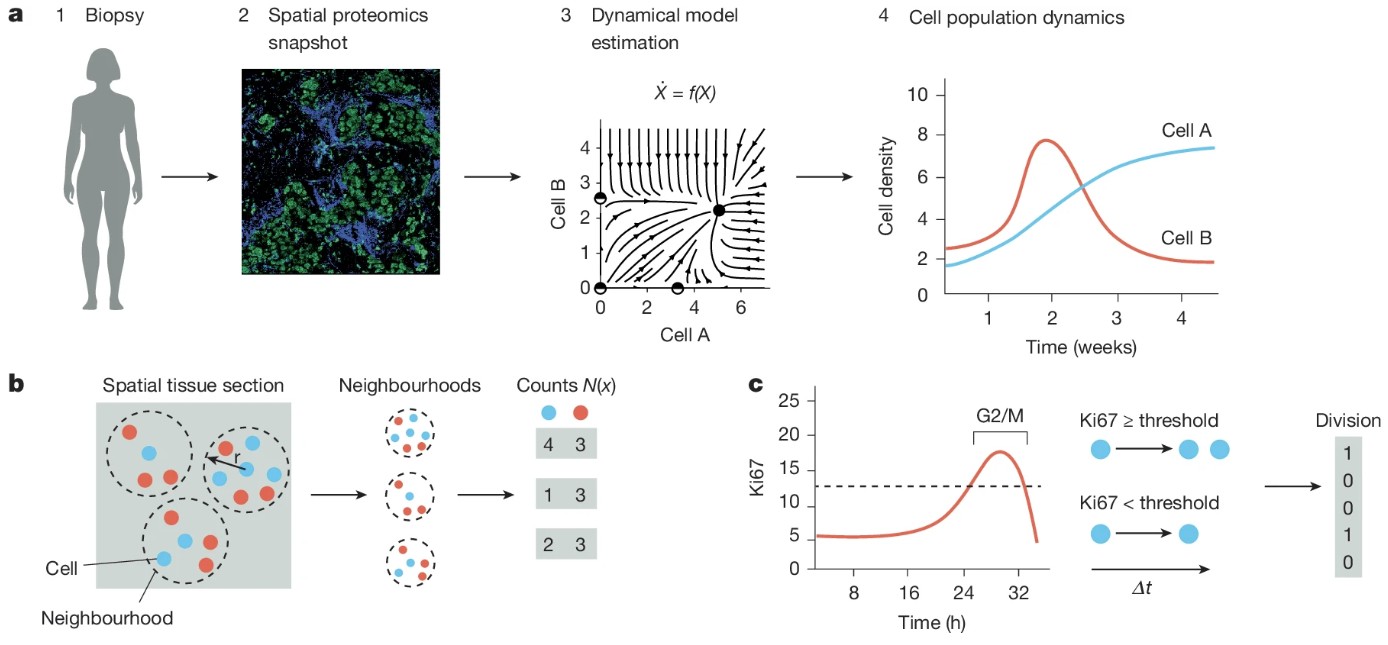
Understanding how cells interact and change over time is central to explaining processes such as cancer progression and immune responses, yet human biopsies typically provide only static snapshots. In a new study spearheaded by the graduate student Jonathan Somer and jointly led by Prof. Shie Manor from the Faculty of Department of Electrical and Computer Engineering and Prof. Uri Alon, from the Weizmann Institute Department of Molecular Cell Biology, the authors introduce One-Shot tissue Dynamics Reconstruction (OSDR), a computational framework that infers cell population dynamics from a single spatial biopsy. By combining spatial proteomics with cell division markers, OSDR learns how the local cellular neighborhood shapes proliferation and removal rates, enabling reconstruction of tissue-level dynamics without the need for longitudinal sampling. This approach addresses a long-standing limitation in human tissue biology: the inability to directly observe population dynamics in vivo.
Applying OSDR to large cohorts of human breast cancer biopsies, the researchers recover known and previously unmeasured dynamical circuits within the tumor microenvironment. The method reconstructs two stable interaction states between fibroblasts and macrophages - corresponding to clinically relevant “hot” and “cold” fibrosis - and uncovers an excitable, pulse-generating circuit between T and B cells that suggests immune activity occurs in temporal flares rather than steady states.
Importantly, when applied to early-treatment biopsies from a clinical trial in triple-negative breast cancer, OSDR accurately predicts whether tumors will collapse in response to chemotherapy or immunotherapy, months before clinical outcomes are observed.
“OSDR shows that biopsies may contain more dynamical information than we previously realized,” said Jonathan Somer. “By reading proliferation signals in their spatial context, we can infer how cell populations are likely to change over time, even in patients where repeated sampling is challenging.” The authors emphasize that OSDR is broadly applicable across spatial proteomics platforms and disease settings, opening a new avenue for studying human tissue dynamics and for predicting treatment response based on early, albeit invasive data
The full study, published on January 22, 2026 in Nature, can be found here.