A Crystal-Clear Difference: Why Some Encapsulated Cell Transplants Survive and Others Fail

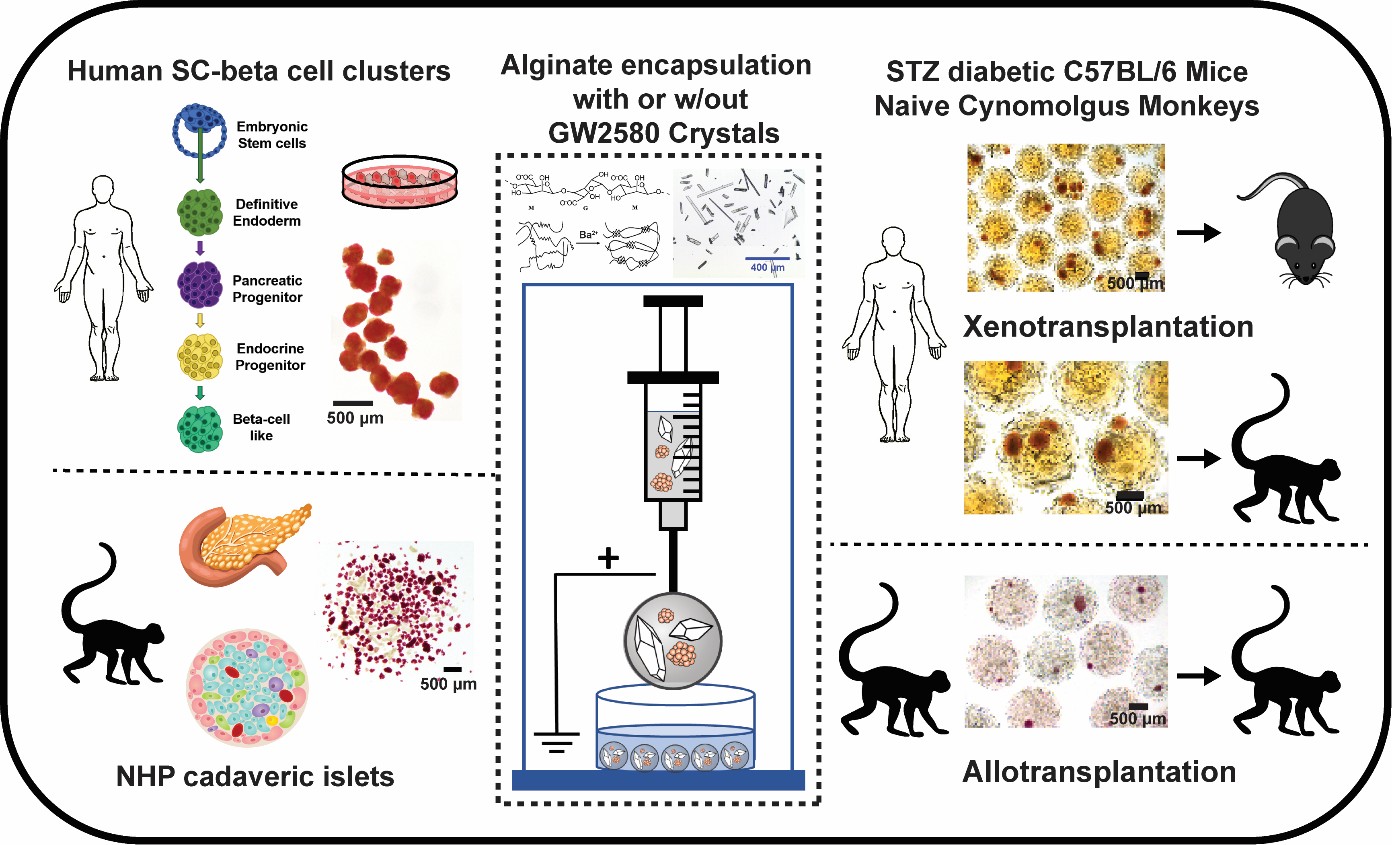
A collaborative study led by Assistant Prof. Shady Farah, from the Technion Wolfson Faculty of Chemical Engineering, Matthew Bochenek from the Massachusetts Institute of Technology (MIT) and Joshua Doloff from Johns Hopkins University, in collaboration with research groups from Harvard University, among others, reports a new strategy to improve the survival of transplanted therapeutic cells by combining immuno-isolation devices with a slow-release antifibrotic drug engineered in crystal form. In this study, the team, which included Dr. Merna Shaheen-Mualim and the graduate students Neta Kutner and Edwar Odeh from the Technion Farah Lab, crystallized GW2580 - a small-molecule inhibitor that targets colony-stimulating factor-1 receptor (CSF1R) signaling in monocytes and macrophages - was embedded directly within semipermeable biomaterial capsules which were implanted in mice and nonhuman primates. The crystalline formulation releases drug locally for extended periods and substantially reduces the fibrotic scarring that normally chokes nutrient and oxygen exchange around implants. By limiting macrophage-driven fibrosis at the implant surface, this localized approach may reduce or eliminate the need for systemic immune-suppressing drugs, which carry serious health risks.
The study highlights an important biological distinction: the approach enabled year-long function of human stem cell-derived insulin-producing cells in immune-competent mice and protected allogeneic (same-species) islet grafts in nonhuman primates, where retrieved implants remained viable and glucose-responsive without systemic immune suppression. However, when the team tested xenogeneic (cross-species) human stem cell-derived β cells in primates, robust adaptive immune activation-marked by increased T cell and B cell signatures and cytokine dynamics-overcame the local antifibrotic protection and led to graft failure despite continued local drug presence.
As Prof. Farah notes, “Separating macrophage-driven fibrosis from adaptive immune activation in a primate model showed us exactly where biomaterial antifibrotic technology succeeds and where it needs help: crystalline GW2580 can buy time and preserve allogeneic grafts, but xenogeneic cells provoke adaptive responses that require additional, targeted immunomodulation.” Shady continued “These important findings opened the door at our lab at the Technion for a follow-up work aiming for engineering multi-targeting crystalline-based strategies for xeno-based implants, among other new directions”
Detailed immune profiling supports this interpretation. Longitudinal serum cytokines and transcriptomic analysis of the tissue microenvironment revealed early innate signals followed by a pronounced CD4+ T cell and B cell response around xenogeneic implants-consistent with an indirect antigen-presentation pathway that activates adaptive immunity even without direct donor-recipient cell contact. These results explain, in part, why immunoisolation systems that perform well in rodents often fail in primates and underscore a clear translational pathway: crystalline antifibrotic drug technology is a promising strategy to achieve long-term, immune-suppression-free allogeneic cell therapies, but xenogeneic applications will likely require complementary strategies that address adaptive immune recognition.
The study, published in Science Translational Medicine on January 28 2026, can be found here.